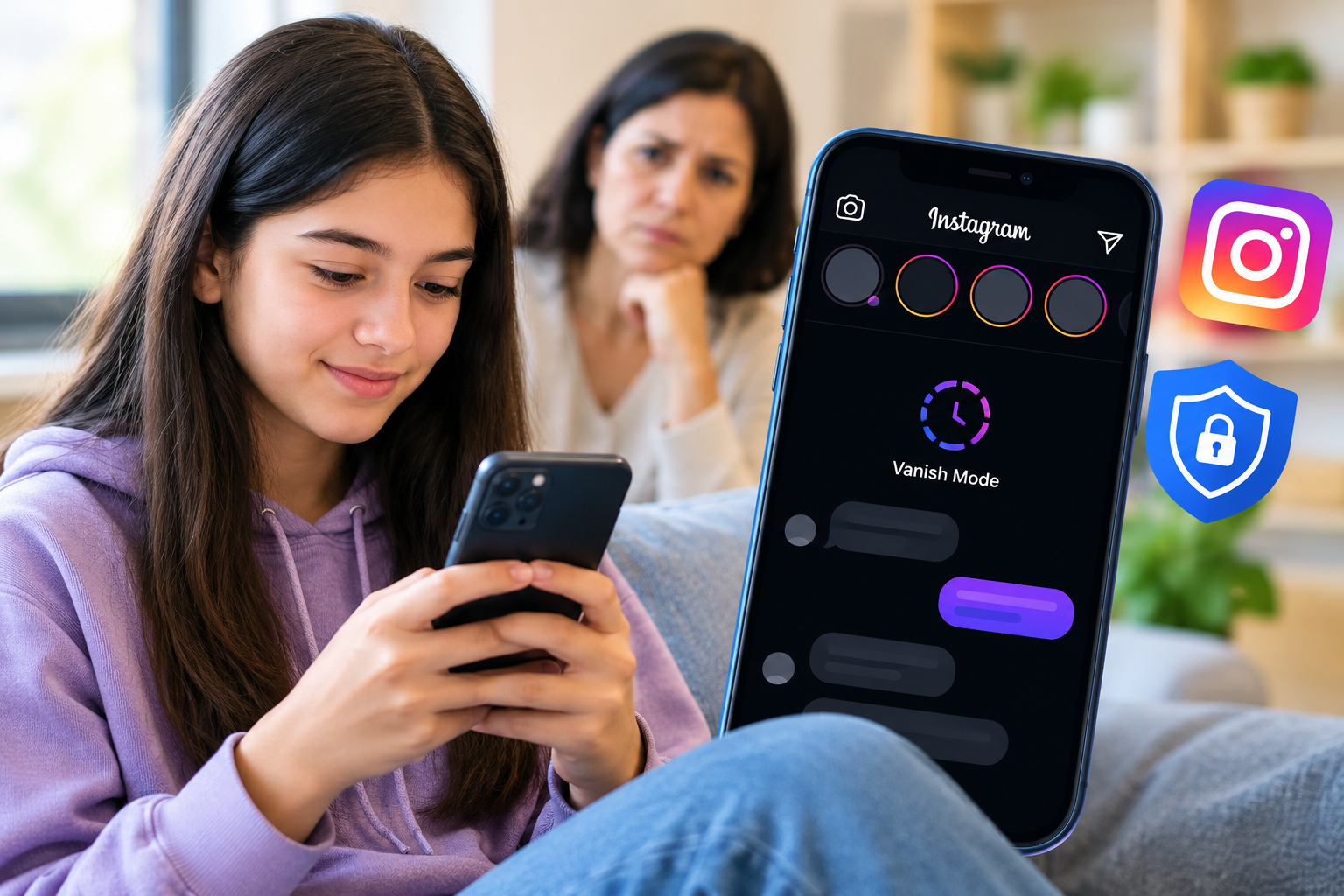
Social media is an integral part of teenagers’ daily routine, connecting them with friends, sharing experiences, and fostering online relationships. Instagram is one of the most popular platforms among the young people, which have direct messaging, Stories, Reels, and Vanish Mode features. Tools like these are convenient for communicating, but can also cause issues with online privacy and safety.
If the conversation settings are set to “make message disappear after viewing” or “close chat after viewing”, then the messages will disappear from Instagram after they are viewed. This is a useful tool for private conversations, but can also create a challenge for parents to understand what their children are exposed to online.
Parents can help their teens develop safe social media habits by understanding how Instagram Vanish Mode works, its potential dangers, and how to use it responsibly.
What is Instagram Vanish Mode?
Instagram Vanish Mode is a messaging function for talking with people where you can see the messages and some shared content and remove them afterward. Unlike a standard Instagram direct message conversation, there isn’t a time limit on messages typically being viewable until they’re deleted.
The feature was added to give users a more “temporary” messaging experience. This may depend on the version and availability of Instagram’s messaging capabilities, as people might have different ways to handle disappearing messages.
Vanish Mode can be appealing to teens because they feel more secure when they’re messaging with friends. But don’t expect complete security or absolute anonymity from disappearing messages!
Parents should inform their children that there can be consequences to online communication, even if the messages are meant to be deleted.
How Does Instagram Vanish Mode Work?
Certain conversations will be different in the Vanish Mode; eligible messages won’t stay in the chat history, but will instead fade away.
It has the following major features:
- Temporary messages: Eligible messages are deleted when they are viewed and the message thread is closed.
- Private conversations: This feature will be used for private conversations, not posts.
- Screenshot notifications: Instagram can alert participants if they see someone’s content is being taken a screenshot in Vanish Mode, but this does not block all ways to capture or share content.
- Different messaging behaviour: Vanish Mode conversations are different from regular direct messages.
It is also important to note that platform features may vary over time and might not be offered in all accounts and regions. It can be helpful to check Instagram’s help documentation to learn about the latest features.
Most importantly, the disappearance of messages can not guarantee that sensitive information will remain private. A person can take a picture of the screen with another device, remember the conversation or even disperse details beyond Instagram.
Is Instagram Vanish Mode safe for teens?
Instagram Vanish Mode is not inherently bad but it can be safe if teens use it and with whom they interact.
Temporary messaging can be convenient if used judiciously between trusted friends. But, the feature can pose issues when young people meet new people, with peer pressure, and when disclosing personal information.
There are a number of variables that affect whether or not Vanish Mode is a risk.
1. Limited ability to see conversations
Eligible messages will be deleted, so teens might not have as many chances to revisit previous discussions. This could make it difficult to prove the existence of inappropriate messages, harassment, threats or unwanted contact.
Parents need to make teens feel okay if they are not comfortable using a speech or conversation for help, don’t just think that disappearing messages are harmless.
2. Feeling pressured to share personal information.
Disappearing messages are one way some individuals try to convince others to send them private photos and information or even content that they wouldn’t otherwise send.
Teens should learn that it is never okay to share if someone asks them to. Consent, personal boundaries and respect are still a key part of all digital interactions.
3. Cyberbullying and Harassment
Ongoing communication of messages and information makes it difficult to recognize cycles of bullying and repeated harassment. A young person might not have an accessible conversation history and receive upsetting messages.
Parents can support by helping children identify manipulative behavior, if necessary, block unwanted contacts, report abusive accounts, and reach out to a trusted adult for assistance.
4. Illusion of privacy
Many people don’t understand disappearing messages, and they think that they cannot be saved or shared with others.
If a platform deletes a message from the chat, someone else can still have a copy of its content. Teens should therefore refrain from posting anything on the web that could be damaging if it got into the wrong hands.
Instagram has a variety of different privacy settings and controls that parents should be aware of
Vanish Mode is just a facet of Instagram’s messaging and privacy landscape. Parents should also be familiar with the other safety features on the platform.
Review Account Privacy
A private account will enable teens to manage who can follow them and view their posts. Parents can talk with them about why it might be better to accept follow requests from people they know, as this will help to minimize unwanted interaction.
But, private accounts are not a safeguard against all unwanted contacts.
Understand Message Controls
Instagram offers some messaging features that can help manage who can send a message request to you and how unfamiliar accounts will interact with you. It’s important to check these settings together so that teens can make decisions.
Find out what blocking and reporting are and how to do it
It is important for teens to learn to block accounts they don’t want to be contacted by and to report harassment, impersonation, or other inappropriate behavior. They should also be told that if they have a concern they should report it, and that it isn’t an overreaction.
Develop an awareness of Teen Safety Features
In select accounts and areas, Instagram supplies teen protections and parental surveillance features. These features can include limitations, alerts, and resources for parents to support their teens’ online experience.
Parents should check the options in Instagram themselves as they can change, and if there are options available, they will be able to see them.
How Parents Can Talk to Teens About Vanish Mode
Sometimes it is more beneficial to have open communication than just a restriction or monitoring. If teens think that every online interaction will result in punishment, they may not want to inform someone about a concern.
Parents can promote a positive atmosphere by talking to them about online privacy, communication and personal boundaries.
Suggest the following strategies:
- Begin with a question: What do you think the point of Instagram is for your teen? How do they use the messaging function?
- Explain Digital Permanence: Talk about how screenshots, screen recordings and other devices can help keep content alive.
- Promote safe sharing: Remind teens to not post passwords, financial information, naked photos, or other personal details.
- Talk about online pressure: Assist them to identify requests for secrecy, threats, manipulation, or unwanted personal information.
- Be nonjudgmental: Be sure to communicate that they can reach out to you if someone sends them an inappropriate message or makes them feel unsafe.
Teens learn to make decisions on their own and are more likely to seek help when necessary through frequent discussions.
Should Parents Monitor Instagram Vanish Mode?
For parents of younger children or who have concerns about their children’s online safety, it may be reasonable to want to know what their children are doing socially online. But, it is important to monitor and trust the child’s ability with age-appropriateness.
Instead of just watching private chats, parents can talk to their child about what they should and shouldn’t do online, look at how they can set up their privacy settings, and set rules for their family’s social media use.
Depending on the features offered, Instagram’s parental management options might offer details regarding some facets of a teen’s account and usage. Disappearing messages and all private conversations should be assumed to be not accessible.
Encouraging more supervision might be suitable for younger teens. For older teens, the discussion might be better with small group discussion where they can make responsible choices and protect themselves.
It’s not just about regulating social media usage. It is to give teenager’s knowledge of risk and safe decision making when parents are not there.
These are the signs that parents should never ignore
Note that using Vanish Mode is not in itself a sign of bad behaviour, but some changes in use may signal that a teenager is in need of help.
Parents should watch for things like sudden distress when talking on the phone, fear of receiving calls or messages, withdrawing from friends, unusual anxiety in relation to internet use or they noticing someone is threatening or pressuring them.
There are several reasons for these behaviors and it is important to not make assumptions. Talk to the teen in a non-threatening way, ask questions, and do not blame.
If the threat, extortion, sexual exploitation or immediate safety concerns exist, keep any evidence in a safe place, report to the relevant authorities or child protection professionals as appropriate and get assistance if needed.
Developing Digital Wellbeing for Teens
Knowing one messaging function isn’t enough when it comes to online safety. Adolescents find it helpful to know how to safeguard their privacy, identify suspicious activity, set their screen time limits, and treat others well.
Parents can help reinforce these habits by setting reasonable device rules, encouraging offline activities, and speaking with their children about real-life scenarios involving potential digital dangers.
Additionally, it’s essential to demonstrate responsible technology usage. Teenagers have opportunities to role model good communication and sharing behaviors, and healthy screen time, when adults do it.
Families should review digital safety agreements periodically to adapt to changing circumstances and evolving features of social media.
Conclusion
Instagram Vanish Mode provides a transient messaging expertise, but should not be seen as an assurance of privateness or security. Teenagers primary concerns are missing evidence, inappropriate requests for personal information, cyberbullying and inaccurate interpretations of how online information can be captured or shared.
By understanding the feature and reviewing privacy and supervision settings, as well as discussing and setting clear expectations for responsible social media use, parents can help mitigate some of these risks.
In conclusion, digital awareness, trust, and appropriate guidance are crucial to keeping teens safe on Instagram. Teaching young people to identify the warning signs, their own boundaries and when to get help, will help to promote healthier and more confident online behavior.