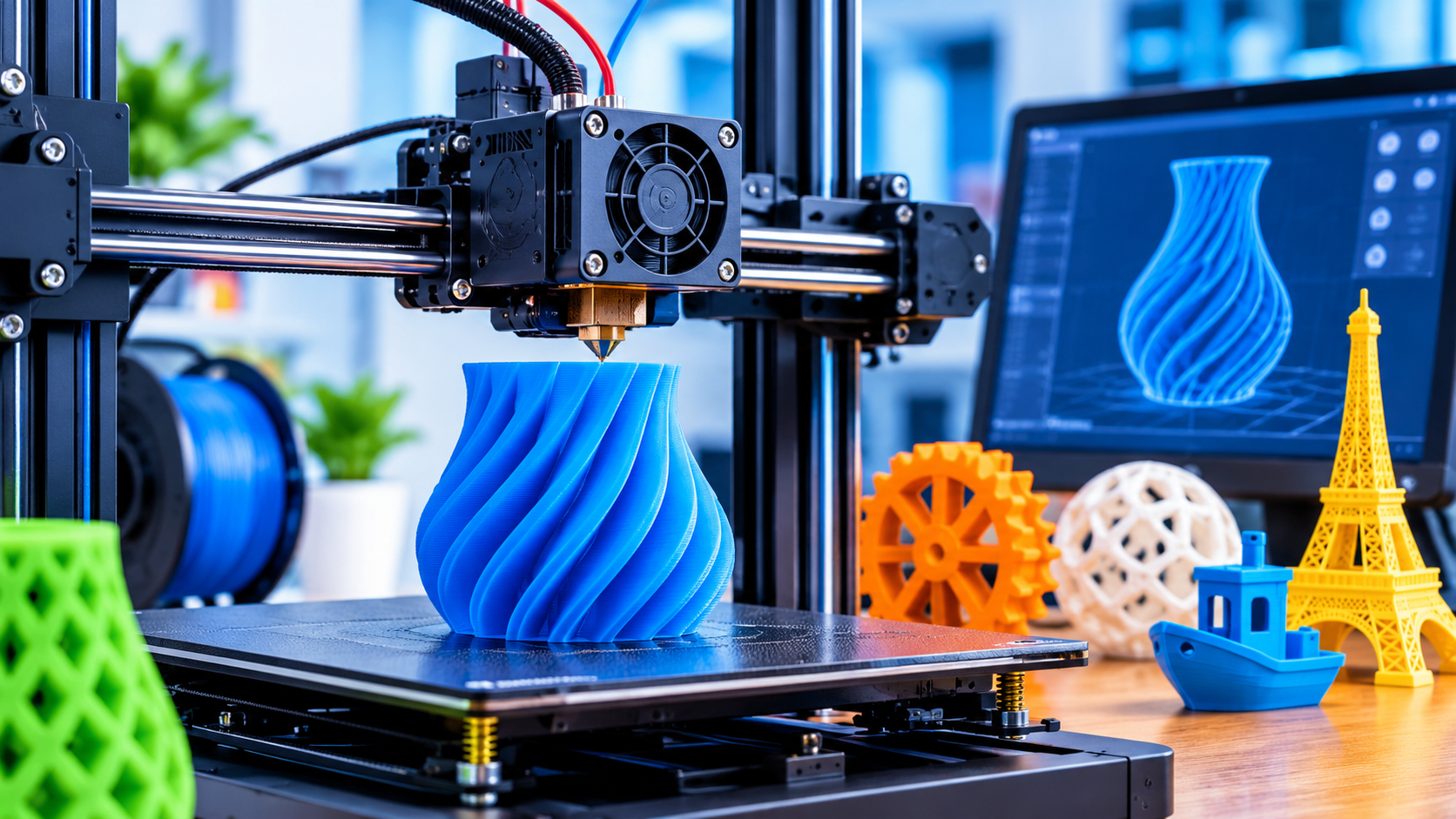
Additive manufacturing (3D printing) is a method of creating three-dimensional objects from digital designs, with layers of material being added together. A 3D printer builds an object up layer by layer, depositing material only where it’s going to be used, and leaves it behind where it isn’t needed–as opposed to cutting or hollowing material away. From a kids’ first homemade key chain to a certificate-approved metal part in a jet engine, the concept has taken flight.
3D printing is the reverse of subtractive manufacturing, in which an object is formed by cutting an object from a solid block with a tool such as a lathe or mill. It is also unlike formative manufacturing, where material is molded in a fixed mold and is only economical at high volume, where the cost of the mold is amortized over many parts manufactured. 3D printing does not subtract, it adds, so can create complex shapes using less material than traditional methods, and can create geometries that would be difficult or impossible to machine, and without a mold. The exception to the layer-by-layer rule is volumetric 3D printing, which constructs a full structure at once; as of 2026, only a few research efforts are making progress in this field.
How does 3D printing work?
Whether it’s a toy on the desktop or a turbine part in the industrial system, every print follows the same three steps: 1) Model, 2) Slice, and 3) Print.
1. Start with a 3D model
It all starts with a digital 3D model. It can be created from scratch in CAD software or be obtained from a model library. Tinkercad is a free, online drawing tool that beginners can use to create printable files like STL/OBJ. If you’d prefer to print and don’t want to create designs yourself, you can find good quality 3D printable models here.
2. Slice the model into layers
A 3D model is not directly readable by a printer and is rather sliced in to hundreds or thousands of horizontal layers. It is a software that slices the model into instructions for the printer to follow, layer by layer, and allows you to adjust some of the parameters, such as the quality, infill, and speed. Find out which are the best 3D printer slicers with our comparison.
3. Print it (one by one)
The sliced file is sent to the printer via USB, SD card or Wi-Fi and the printer constructs the object layer by layer. The technology dictates the formation of each layer, whether it is from melted plastic or resin cured via light, metal powders fused with a laser, as described below in the 3D printing types section. When you use 3D printed parts, you may encounter new vocabulary, consult our 3D printing glossary.
Introducing 3D printing at home
The year 2026 is even more accessible to 3D printing than the past. Now, there’s a capable and really easy-to-use printer for about $200 that prints without much assembly or calibration and comes with massive libraries of free models you can print with a single click. If you’re considering starting, here’s a short version of all you have to come to a decision with a deeper version behind each one.
Selecting the initial printer
The most important choice is the machine itself, and the silver lining is that the price of the lowest of the low-end bar has fallen drastically. Most people’s first printer is an easy to use, well supported filament printer that prints without hassle. Our list of the friendliest 3D printers is followed by our best 3D printers roundup, which covers all the 3D printers from beginner to prosumer.
Filament or resin?
There are two types of consumer technologies: FDM (melted filament) and resin (liquid cured by light). For the vast majority of newbies, FDM is the simpler, cleaner, more forgiving starting point. Resin is great for fine detail jobs such as miniatures, but requires chemical handling and more careful safety. The FDM vs resin comparison spells out the pros and cons, and if you’re a resin fan, the best resin 3D printer guide has the recommended list.
What it costs
A decent set-up costs in the region of $200 to $350 (with the printer, some rolls of filament and a basic set of tools) and filament (PLA) costs are around $20 to $25 per kilogram. The costs increase as you increase your printing volume and/or machines. The 3D printing cost guide helps us to dissect the actual first-year figures from a side-project to a small print farm.
Staying safe
When done sensibly, all 3D printing is as dangerous as operating a hot glue gun: The only things to keep an eye on are the hot nozzle, the hot bed, the air quality, and the skin protection for resin printing, and the fume protection. It is not exotic, but it’s good to get right before your first print. Our 3D printing safety guide includes explanations of fumes, burns, fire, and resin handling.
For kids and classrooms
The ability to create with 3D printing is an amazing way to engage kids in hands-on STEM, and the job is easy with the right printer and proper supervision. All the way from children’s age-appropriate printing to the supervision required to use a 3D printer, from printer ideas for kids to classroom setup, our guide for 3D printing for kids and schools has you covered.
Types of 3D printing technologies and processes
The term 3D Printing” is a catch-all for a number of different technologies that all involve the creation of objects from layer-by-layer construction—in different ways. In practice there are six families, classifiable into seven categories in the international ISO/ASTM standard. It’s up to the material, the detail you want and the budget, ranging from a desktop filament printer to an industrial metal system. For home printing, the most common type you’ll find is material extrusion (FDM), the 4th family below.
1. Vat photopolymerisation
A printer based on vat photopolymerisation has a container of liquid resin that is hardened, layer by layer, with a UV light source. The highest detail family, the foundation of consumer resin printing.
3D Systems’ founder Charles Hull invented stereolithography (SLA) in 1986. The UV laser is used to trace each cross-section on the surface of the resin, curing it and fusing it to the layer underneath, the platform is then moved by one layer thickness and the process is repeated. Typically, SLA requires the support structures. Digital Light Processing (DLP) is similar to this, but is faster because it flashes an entire layer at once through a digital light projector. Carbon’s Continuous Liquid Interface Production (CLIP) creates a thin “dead zone” of uncured resin that allows the part to not adhere to the bottom, paving the way for fast and continuous printing.
This family is encountered by most hobbyists in resin. Compare FDM to resin printing in our FDM vs resin comparison, and our resin 3D printer list for the latest resin printers.
2. Material jetting
Material jetting prints the build material droplet by droplet from the nozzles, like a paper inkjet printer, onto the build platform and cures it by using UV light, layer by layer. It is capable of depositing droplet by droplet multiple materials and colours, making it very suitable for smooth, full-coloured multi-material parts, but the photopolymers are expensive.
3. Binder jetting
Binder Jetting is based on two materials: powder base and liquid binder. The powders are thinly laid over the build chamber and binder material is jetted over the top of them to “glue” the powders to create the shape desired; then the powders are again spread over the top. The powder that remains around the print after it has been printed is cleaned off and can be reused. It was first developed at MIT in 1993, and is an established process for making full-color sandstone models, as well as for metal parts which are subsequently sintered.
4. Material extrusion (FDM)
Nearly every home printer uses material extrusion as its technology, which is the most common. A plastic filament is pulled from a spool and pushed through a heated nozzle that melts the plastic, which is then extruded in horizontal and vertical layers, controlled by a computer, and immediately cools and solidifies.
In the late 1980s, Scott Crump, who was then at Stratasys, invented Fused Deposition Modeling (FDM) and founded Stratasys in 1988. Fused Filament Fabrication (FFF) is an equivalent term coined by the RepRap project so it could be used without trademark constraints. This is the family to start with: see our best 3D printers for beginners.
5. Powder bed fusion
In the case of powder bed fusion, the material is fused together by heat from small particles of powder in the bed. Each cross section is scanned and fused by a heat source, the bed is lowered by one layer, and another layer of powder is applied. Selective Laser Sintering (SLS) is a process in which polymer powder is fused using a laser, with no need to provide supports as the surrounding powder provides support. Multi Jet Fusion (MJF), created by HP, deposits powder, then jets the binding and detailing agents onto the surface, followed by a thermal explosion to fuse the layer. The same principle is used in Direct Metal Laser Sintering (DMLS) which has progressed to complete laser melting for dense metal components.
6. Directed energy deposition
The primary use of directed energy deposition (DED) is in repair and large-part applications, and primarily with metals. The energy source (a laser, electron beam or plasma arc) melts the metal powder or wire on the surface, which is fed through a nozzle by the print head, usually attached to a multi-axis robotic arm. It can deposit material at high speeds and is useful for metalizing existing parts, making it useful for repairing high-value parts.
3D printing materials
Materials used for additive manufacturing are very diverse, ranging from plastics to metals, resins, ceramics, concrete, paper, and even edibles such as chocolate. They commonly are in one of three forms: wire feedstock (filament), powder, or liquid resin. In the home environment the most popular starting material is the low-odour, cheap, easy-to-use, plant-based plastic called PLA.
The majority of home printing is done with FDM filament and within that single category, there’s a choice to make. The obvious answer is PLA, inexpensive and forgiving, perfect for models, toys and learning. PETG offers a bit of that convenience for its water resistance and toughness, making it ideal for functional parts. ABS and ASA can be used outdoors and will resist heat, but must be kept in an enclosure with good ventilation. Flexible filaments like TPU perform the functions required of parts that need to bend or grip. Where strength and temperature resistance is important, engineering filaments, such as nylon and polycarbonate, come into play, and composite filaments, with a carbon or glass fibre content, are stiffer. Here, we have combined all the material types of our 3D printer filament guide. Other bio based filaments are also available and they are made from renewable feedstocks.
In addition to filament, resin printing applies a liquid photopolymer that is hardened by light and industrial printing employs metal, ceramic and even concrete powder. For a deeper dive in each of them, check out our materials category.
What 3D printing is used for
3D printing is not a single industry by any means, it’s a collection of industries, and there are countless applications. Here are some examples that can be used to give you a sense of the variety of things that can be made using this material: consumer products like eyewear, footwear, furniture; industrial tools, jigs, and end-use products; dental products and prosthetics; architectural scale models; fossil and antiquities reconstruction; forensics; and movie props.
Rapid prototyping and manufacturing is where it began. Designers have been using 3D printers to create prototypes since the late 1970s, as it’s quick and budget-friendly, getting an idea to a part in hand in days, rather than weeks, which is not possible with expensive molds. With the same speed, production is now in the short run.
Automotive and aerospace used to be early adopters. Car manufacturers print spare parts, tooling, jigs and end-use parts for on-demand printing, and enthusiasts print parts to restore vintage cars. For aerospace, additive offers lightweight and compact designs, and approved printed metal components are already in use on commercial planes and in rocket engines. Get the latest news from the automotive and aerospace hubs.
3D printed houses have gone from idea to reality; some companies are printing parts in a factory setting, and others are 3D printing on-site using massive concrete printers.
Consumer items feature cast-patterned jewelry, 3D-printed shoe midsoles and eyewear frames, as well as 3D-printed eyewear lenses.
Healthcare is one of the areas with the highest adoption rate. Over the last decade, GE Additive has 3D printed over 100,000 hip replacements, over 99% of hearing aids are 3D printed for dental applications, and clear-aligner molds for dental work are among the most 3D printed objects in the world. Scientists are also making progress on bio-printing – creating tissue structures using living cells.
The picture is completed by food and education. Printed food is used as a restaurant signature while 3D printers are being used for classrooms so that students can print their ideas at a low cost and in a short time. Our 3D printing for kids and schools guide is for those introducing it to young makers, and covers printers, supervision and lesson ideas.
The 3D Printing Industry at Large
Adoption has taken off and additive manufacturing is no longer a prototyping tool, but a production technology. Although the bulk of the market remains industrial, the consumer printer market has expanded by a great deal, as desktop printers became affordable and reliable.
Hardware comes in a wide range of prices. A good quality desktop FDM machine can be purchased for a couple hundred dollars, while hobbyist resin printers are in the low thousands and prosumer printers are in the low thousands. Most of the production capacity remains with industrial buyers, as professional and industrial machines start at about ten thousand dollars and go up to the hundreds of thousands of dollars for large metal systems. Our full cost breakdown demonstrates the costs for a real setup at the consumer end from hobby to small print farm.
According to Precedence Research, the global 3D printing market will reach approximately $35 billion by 2026 with a CAGR of nearly 18% and is expected to exceed the $150 billion mark by 2035. The technology is still in its infancy and will dramatically affect nearly all major industries it impacts.
3D Printing Services
Not ready to purchase a printer yet, or require a part in a material or size too large for your printer? Online 3D printing services (also known as print bureaus) will manufacture a component upon request from your design and deliver it to you. It’s a low commitment means to have a one-time printed in resin, nylon or metal without having to buy the machine, and it’s a good choice for materials and build volumes that desktop machines cannot access.
Frequently asked questions
What is 3D printing?
Additive manufacturing (3D printing) is the construction of a 3-dimensional object from a digital file, by adding the material to the material. It contrasts with subtractive manufacturing, which removes material from a solid block to create the object, and allows the creation of complex shapes with less material.
How does a 3D printer work?
It takes three steps: First, create or download a 3D model, then slice the model into hundreds of thin layers using slicing software and send the slices to the printer, which layers them up over time to create a 3D object. The manufacturing methods used vary by layer, including UV-cured resin, melted plastic or laser fused metal powder.
How long does a 3D print take?
It depends on the size, layer height, infill and speed. It takes 20-40 minutes to produce a small and simple object such as a keychain, a few hours for a typical desktop print job, and 10-20 hours or more for a large or complicated model. The resin prints are timed by height not volume, so multiple small prints can be on a single plate and will take nearly as long.
What can be printed with 3D printers?
Plastics, resins, metals, ceramics, concrete, paper and even edibles such as chocolate. Typically materials are presented in filament (wire on a spool), powder or liquid resin. PLA is the most popular starting material for home printing, as it is an easy, cheap, low-odour plastic from plants.
Difference between FDM and resin 3D printing?
FDM uses a nozzle to melt plastic filament, and it’s also the simpler, cleaner and more forgiving method, making it great for novices. Printing using a resin cures the liquid photopolymer and gives higher resolution; however, it requires chemical handling and careful safety measures. To compare FDM vs resin, we’ll need to consider the pros and cons.